

Portobello Road smells like coffee, damp canvas, and the unique mustiness that sticks to old leather and wool that have been kept in someone’s attic for thirty years on a Saturday morning in late spring. By nine, the stalls beneath the Portobello Green canopy are already packed. A young woman wearing platform boots checks the seams on a 1990s Carhartt jacket by holding it up to the light. A sixty-year-old trader observes her silently from behind a table piled in silk scarves and buckled leather bags. She purchases it. He relocates to replenish.
On one of London’s most well-known streets, this scene is played out hundreds of times every weekend. What has changed in recent years isn’t the location or the merchandise, but rather who is buying. Customers are now younger, more picky, and far better informed about what they want. When they arrive, they know just which Burberry trench era they are looking for, how a real Ralph Lauren polo from the 1980s differs from a replica, and the proper stitching pattern for a vintage McQueen item. The traders, many of whom have set up shop on this route for decades, have taken notice.
This change is supported by significant numbers. According to ThredUp’s 2026 Resale Report, which was created in collaboration with GlobalData, the global market for used clothing was estimated to be worth $257 billion in 2025 and is expanding two to four times more quickly than traditional retail.
According to Bank of America’s card data from 2026, Gen Z currently makes up 41% of all secondhand vendors, and 73% of Gen Z consumers have made secondhand purchases in the previous year. This is hardly an obscure pastime. Physical markets like Portobello Road are at the legitimate, tactile end of a huge ecosystem that stretches from Depop listings to Vestiaire Collective to Vinted and back again. It is a dominant shopping behavior for an entire generation.
The sensation of handling anything before purchasing it—feeling the weight of a waxed cotton jacket, inspecting the lining of a bag, evaluating the fading on a pair of vintage Levis—is what real dealers give that no software can match. Additionally, there is the transfer of knowledge. The greatest dealers in Portobello are experts: bag merchants who can date a Mulberry by its hardware alone; military surplus veterans who understand the difference between authentic East German gear from the Cold War era and a replica.
A generation that was brought up on authenticity and investigation is eager for that knowledge, which has been amassed over decades of sourcing and selling. The old adage about vintage shopping—that you had to know nothing and be in the right charity store at the right moment—no longer holds true. These purchasers are ready.
The ease with which this works for all parties involved can be overstated. Some seasoned dealers have found the younger generation to be demanding and sometimes draining; they are social media literate enough to post negative pricing comparisons online and smart enough to haggle aggressively. Due to dealers’ increased awareness of what products sell for on resale platforms, prices on Portobello have increased, which has caused some purchasers to return to Depop. The feedback loop hasn’t fully stabilized. Additionally, there is the constant conflict between maintaining the market’s unique identity and making room for the unavoidable: vintage items go through Instagram before they get through the stand.
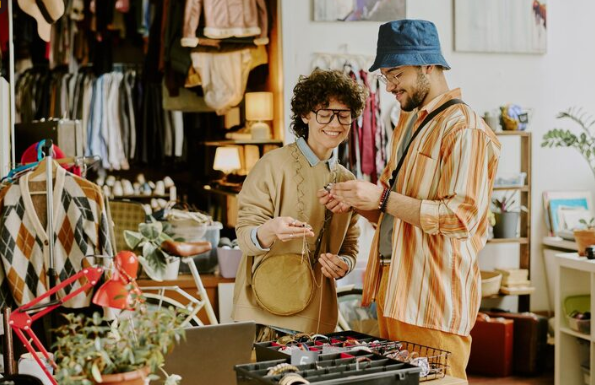
Nevertheless, there’s a sense that Portobello has found a second wind rather than a gradual decline when you watch a Saturday crowd move through the market: the casual browsers, the archival seekers, the merchants calling across to each other in a shorthand developed over years. Digital resale platforms were meant to pose a threat to physical antique retail. Rather, it appears that a generation accustomed to online shopping still desires a place to go, something to hold, and a transaction that is more like exploration than a purchase. Since the 1940s, the market has existed. It has endured a great deal. The contemporary era appears to be more of an asset than an issue, shaped by Gen Z’s unique and distinct thirst for the actual thing.
