

Ian Haggerty and Di had no intention of becoming symbols of anything. In Mollerin, three hours northeast of Perth, where summer temperatures hover around 35 degrees Celsius and the sky is merciless, they began with 1,630 acres of arid Western Australian farmland. Thirty years later, they oversee 65,000 acres, and on land that most people would have dismissed, Australian Ringneck parrots fly between gum trees along their roadsides.
More can be learned about the potential of regenerative wool farming from that particular detail—parrots returning to previously bare and cracked land—than from any soil report.
Conventional grazing in Australia’s rangelands followed a simple, and ultimately destructive, logic for well over a century. Keep the animals on the ground. Continue to provide the wool clip. Compacted earth, stripped ground cover, and topsoil that washed off in the first heavy downpour or blew away in the wind were what that approach left behind in many places. Damage was gradual at first, then abrupt. The land had already lost something that takes decades, sometimes longer, to rebuild by the time many graziers became aware of it.
Livestock are not rejected by the regenerative movement. Perhaps the most paradoxical aspect of it is that. Rather, it uses the animal as a tool for healing. Sheep are grouped into large mobs and swiftly moved through smaller paddocks under what is generally referred to as Holistic Planned Grazing, simulating the movement of wild herds across grasslands.
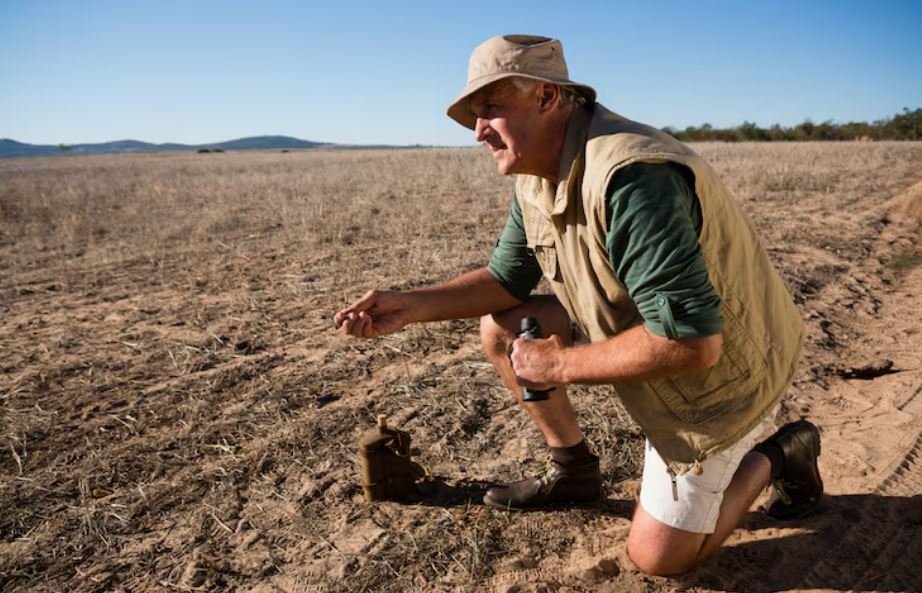
The grazing is brief and intense. After that, the land is left to rest for a few weeks or longer before being grazed once more. Native perennial grasses, the deep-rooted variety that have adapted over millennia to these soils, have an opportunity to reappear during that recovery window. And when they do, they store carbon underground by drawing it down from the atmosphere.
This is no longer fringe soil science. The soil can hold thousands more liters of water per hectare for every percentage point increase in soil organic matter. That kind of water retention is not only ecologically beneficial in the Western Australian Wheatbelt, where rainfall has decreased by about 30% since the 2000s, but it also makes the difference between a farm surviving a drought and not.
Additionally, the Haggertys have discovered something more difficult to measure. “Across 65,000 acres, we’re affecting large water cycles now,” Ian said to a reporter who was there. It’s the kind of assertion that raises questions, but it’s worth considering. At scale, the effects of land that retains more water, produces more vegetation, and lowers surface runoff don’t neatly fit inside a fence line.
The market has evolved over the last few years. Global fashion brands are beginning to pay attention as consumers and regulators put more and more pressure on them to disclose the origins and production methods of their fibers. International supply chains can be connected to verified, regenerating landscapes through certification frameworks such as Land to Market, created by the Savory Institute. Over 662,000 hectares in 97 Australian farms have been under this type of outcomes-based, monitored management since 2021. In just one year, the percentage of farms that were categorized as actively regenerating increased from 58% to 85%.
The tale of the wool and soil has also taken an unexpected turn. Degraded soils are directly treated with pellets made from low-grade wool fibers, which are too coarse or damaged to weave into anything. Water is absorbed by the fiber at a rate that is about twice its own weight, and as the ground dries, the water is gradually released. The pellets decreased surface evaporation and increased microbial activity in nearly biologically inert soils, according to field tests conducted in Queensland and New South Wales. It is round, unglamorous, and actually helpful. An issue with disposal evolved into a soil amendment.
It’s still unclear how quickly this strategy can be scaled up or if enough graziers will switch before the underlying damage is accelerated by another ten years of drought. A different kind of attention is needed for regenerative farming, one that involves reading the land instead of using a set formula. In the short term, not every farmer finds that change to be simple or easy financially.
However, the parrots have returned to Mollerin. When the wheat is harvested, it stands tall. Mulla Mulla, a native plant that most farmers spray off as a pest, now grows freely on land that the Haggertys purchased as nearly useless dust because its tap roots draw nutrients up from deep within the ground. It’s a minor detail. It’s also the entire narrative.
