

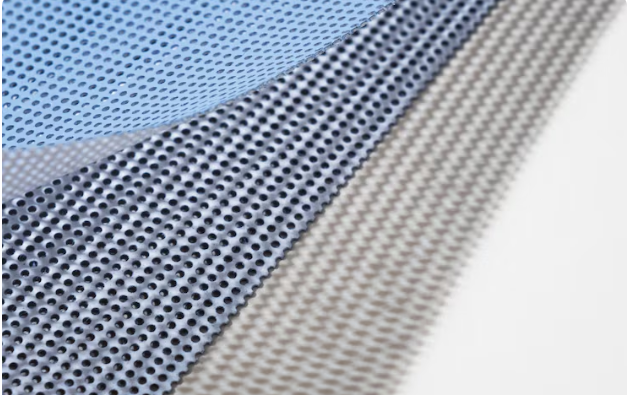
It doesn’t appear to be much material. Nanoporous polyethylene, which comes from the same family of plastics used to wrap groceries, resembles a finely woven mesh under a microscope. It is transparent in visible light and perforated at a size measured in nanometers. To put it succinctly, it is the last thing you would anticipate serving as the foundation for a very noteworthy textile innovation. However, research from Stanford’s Yi Cui group over the past few years indicates that this material may be able to achieve something that no fabric in the history of clothing has been able to do: keep you significantly cooler than cotton without using any energy at all.
Although it required years of materials science to implement at scale, the underlying notion is straightforward. The human body continuously emits infrared radiation, which is a mid-wavelength emission that is blocked by traditional textiles. Conventional cotton traps heat near the skin, increasing the body’s surface temperature and prompting you to turn down the thermostat. It is not trapped by nanoporous polyethylene.
Because the material is designed to be transparent in the infrared wavelength region, heat radiation from the body can easily travel through it and dissipate into the surrounding environment. When compared to commercial cotton of comparable thickness, NanoPE fabric exhibited a 2.3 degree Celsius cooling impact in laboratory tests. If widely used, this difference would result in an estimated 20% reduction in indoor cooling energy.
The production pathway is what makes this not only scientifically elegant but also commercially interesting. Researchers at Stanford showed that current industrial knitting and weaving machinery may be used to manufacture NanoPE fibers. This is crucial since the majority of textile discoveries fail not in the lab but rather in the transition from lab-scale production to factory-scale manufacture.
Companies like LifeLabs, a business that secured over $10 million in a pre-Series A investment in September 2025, are working to close that gap by modifying the underlying nanotechnology for products that actual consumers may purchase. They have already tested their WarmLife and CoolLife yarn technologies under conditions that would stress-test any material, such as an Antarctic expedition in December 2025 where the team climbed Mount Vinson at negative 30 degrees Celsius while wearing equipment designed around these textiles. These technologies are directly derived from the same infrared-management logic Stanford pioneered.
When you think about what it would actually mean to do away with active thermal management in clothes, it becomes easy to comprehend the fashion industry’s desire. Globally, central heating and air conditioning represent massive energy demands. Sustainability credentials, customer comfort, and prospective regulatory pressure from the EU’s developing eco-design regulations are all simultaneously addressed by a fabric that maintains human comfort through passive radiative physics without requiring any additional energy input. The pitch is even more straightforward for performance and apparel brands: in hot-weather athletic applications, a fabric that cools through radiation in addition to draining moisture through perspiration might far exceed anything now available.
It’s important to be open about the problems that still exist. At scale, NanoPE must compete with materials that have undergone decades of industrial development in terms of cost, durability, and hand-feel—the tactile quality that decides whether anyone actually wants to wear something. Despite its engineering, polyethylene does not now feel or drape like cotton or wool, and consumer adoption of smart materials has generally lagged behind the technology itself. Another issue is coloring: more study into particular inorganic nanoparticle compounds is needed to create infrared-transparent materials in a wide spectrum of colors without sacrificing their thermal capabilities. This work is still underway.
